
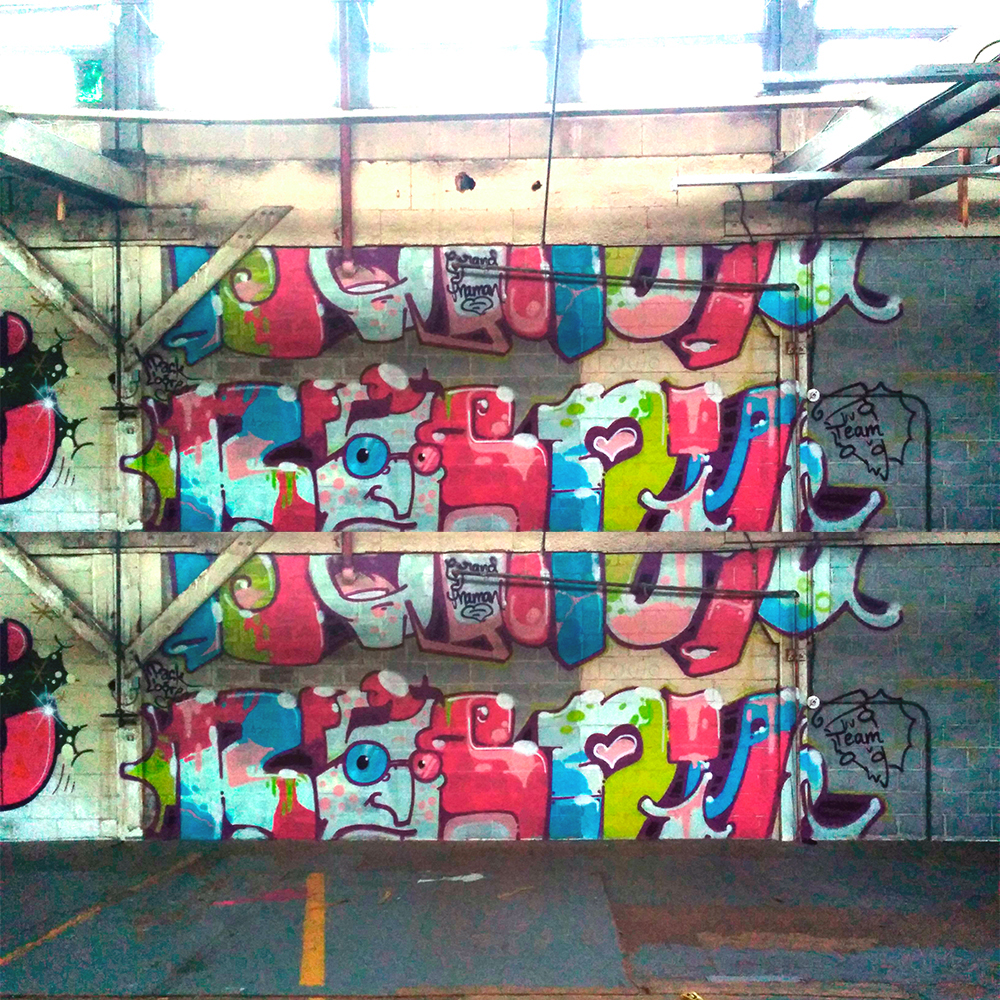
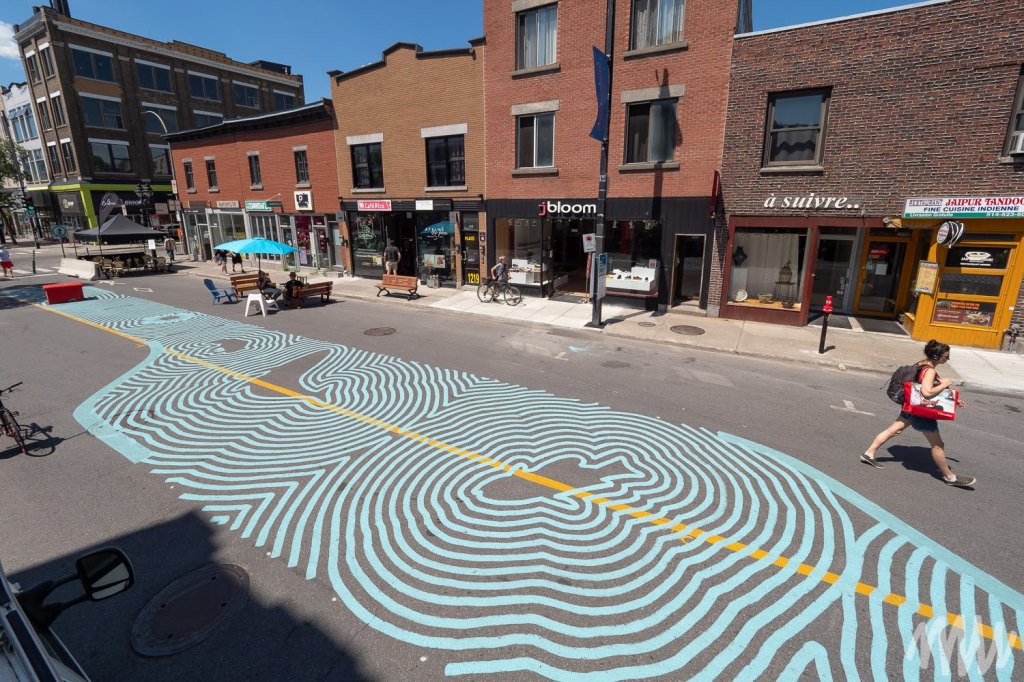
On the 7th of December I sat down with Bosny, a Montreal based muralist. If you’ve walked around NDG, The Plateau or anywhere else in the city, you’ve probably stumbled across his work. We talked illusions, print vs paint, and math humour while sipping Ouzo over ice.
N.810 – When did you decide to pursue art as a career?
Bosny – I started making art younger than an age when I needed to know what my profession would be. At 14 or 15 I was asking business owners if I could paint on their walls, asking for murals, and I just kept doing it. While everyone was figuring out what they would do, I realized, I’m already locked into this job with no clear future. It was less of a decision to make art and more a decision to not stop making art.
N.810 – How was the transition from street art and murals to exploring different mediums?
B. – Before I drew graffiti I was obsessed with impossible shapes. There’s the Penrose triangle which doesn’t realistically connect anywhere and I would try to draw my own. Later I started doing classical drawing and painting classes, then I studied Fine Arts. I always drew non-street art types of things, it’s more a question of having that work be popular or seen by others. For a long time, people only knew my graffiti and my murals, but now people know me for other things as well. The practices were always there but what drew attention to it was going to university for Fine Arts and producing a lot of work other than murals or graffiti.
N.810 – What’s your opinion on art school? Was it worth the investment?
B. – My opinion changes, though I’m in favour of it these days. The problem with art school is art itself is so broad and wide reaching, there’s not really any way for it to be taught at this point. However, it needs to be taught more than ever because you need to be better than everyone else in your specific field. You’re not just a muralist anymore, you’re a muralist who does portraiture, or black-and-white, or uses spray paint, we’re in a world within a world so you need to learn everything about that microcosm. Fine Arts school is more of a catchall, it’s really hit-or-miss. Some profs teach you the basics of a specific medium in a wonderful way, others are already in their own microcosm. If you want to be a part of that world that’s great, but if you don’t, that’s too bad. Not everyone’s painting flowers, plants and naked women, it’s a lot more diverse, so it’s harder to teach. There’s a lot of time spent on criticality and intersectionality, these are great, and getting artists to figure out their message is very valuable and important. But schools don’t put as much work into showing them how to do it efficiently and clearly. If you go to a critique, the artist will explain the piece for 20 minutes. In a museum you don’t get those 20 minutes. Training people technically is very challenging because technique and taste are so varied these days. It was difficult for me because I wanted my primary practice to be painting murals, but they didn’t teach mural painting in school, so I pivoted to printmaking which felt very similar. I started my undergrad in Halifax at NSCAD, it was really fantastic, but I was getting opportunities in Montréal that I didn’t have out there so I came back. The difference I realized was out there I really felt there was a little family, I knew everyone there. In Montréal there’s no ‘First-Year Foundations’, no procedure for new students. That led to me taking a lot more time for my degree because I was disconnected from my peers. Part of my issue with art school is an issue with Montréal art schools. It’s a capitalistic issue, NSCAD is floundering and struggling financially because they put their students first. Whereas Montréal’s bigger institutions prioritize money more than NSCAD does which allows them to stay afloat at the students’ expense.
N.810 – Recently you’ve been working with optical illusions, where did that need to return to your impossible shapes of elementary school arise from?
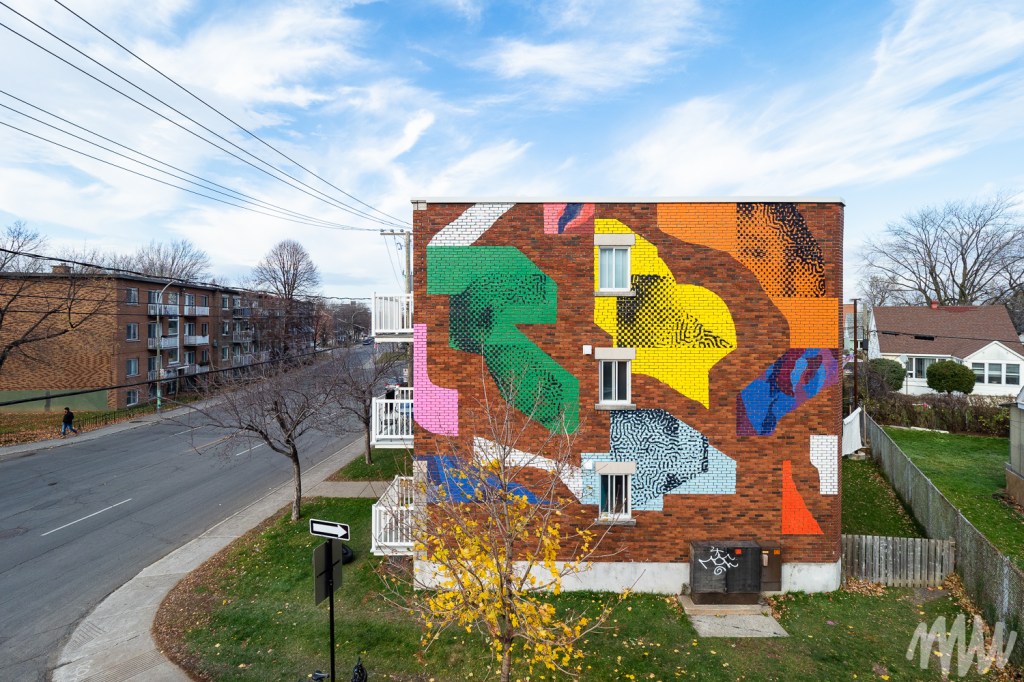
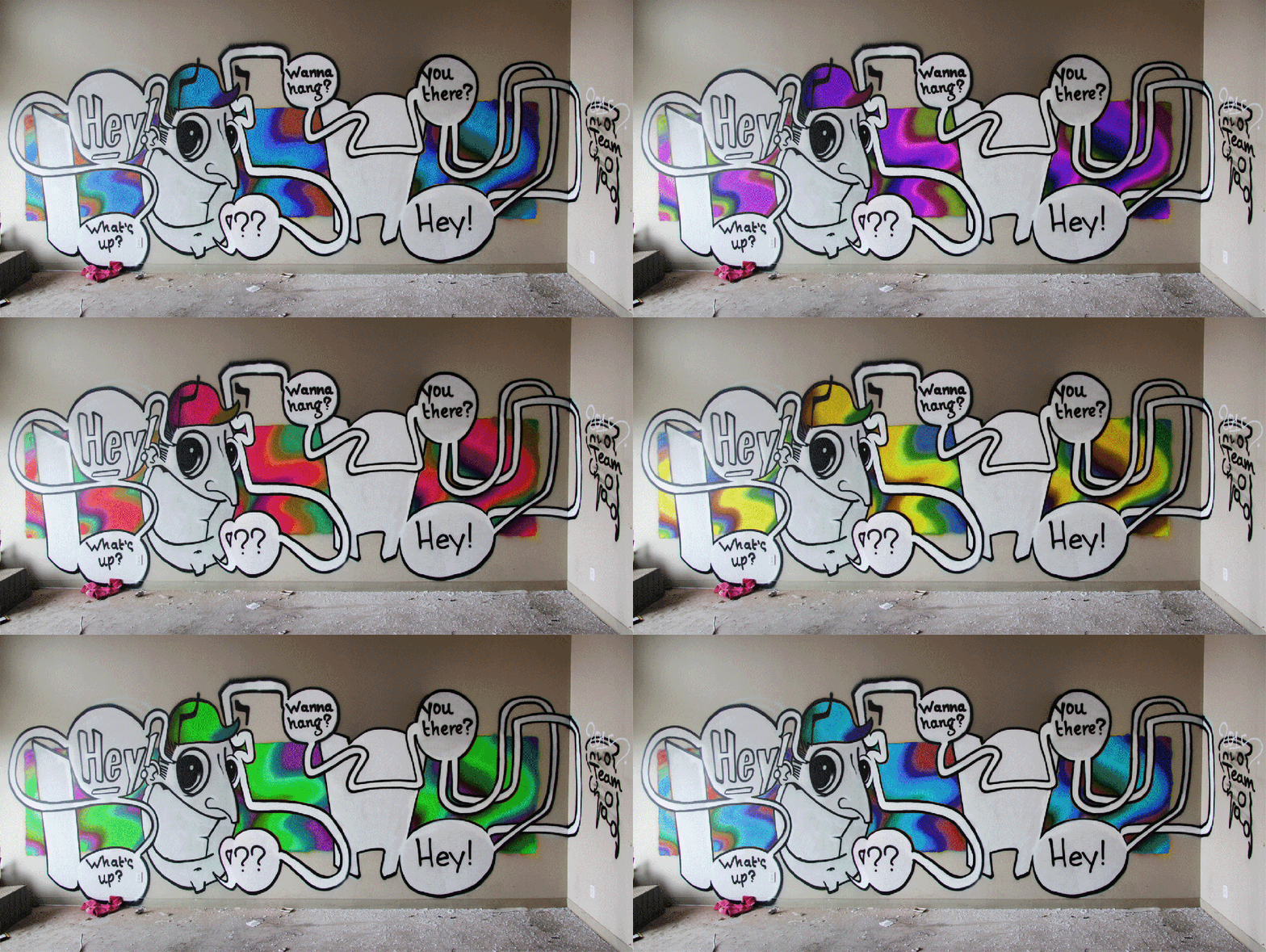
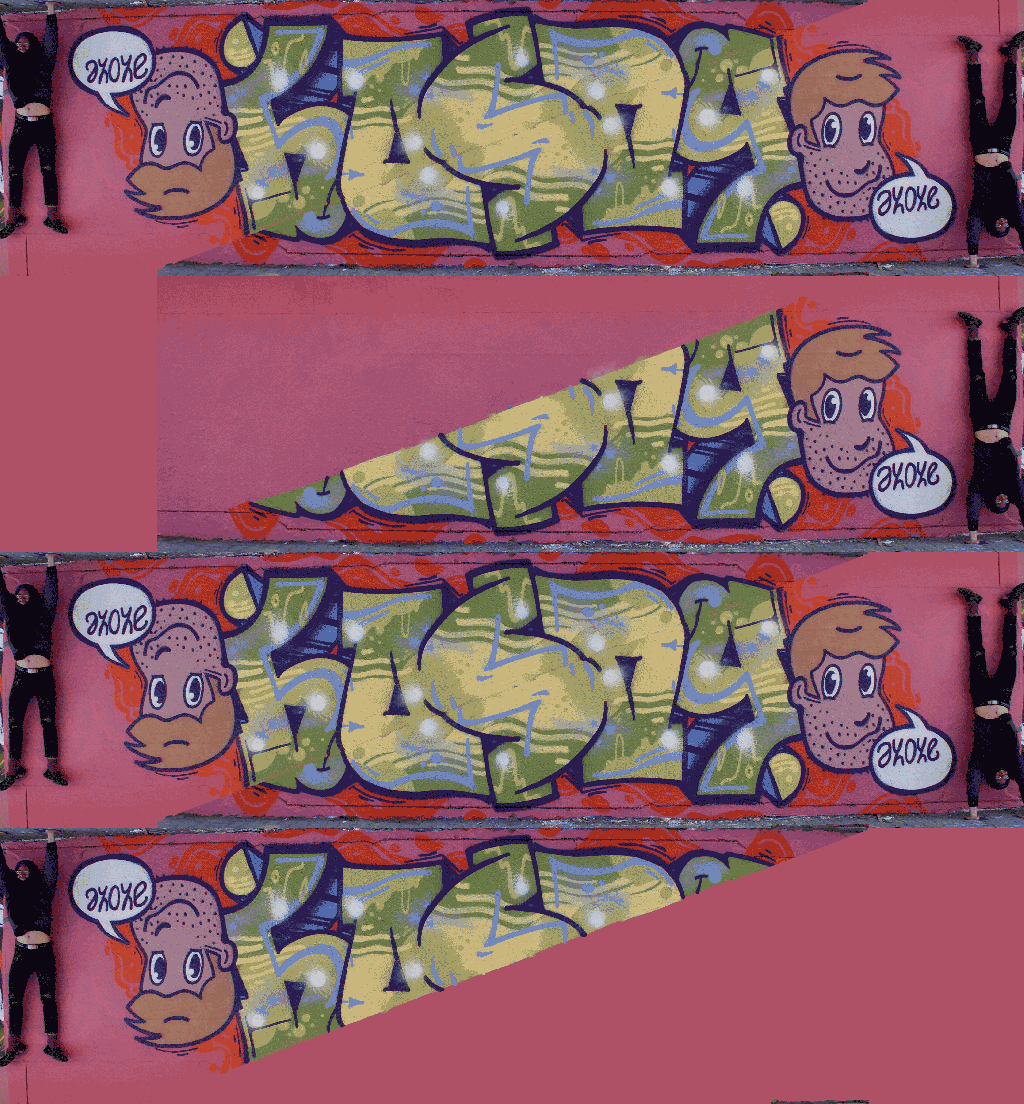
B. – One of the big things was becoming comfortable with the fact that I’m not a very cool person. I’m kind of dorky… I like math related things and I come from a family of dorks. We like shitty puns and exchanging math humour, that’s my family. After adolescence in my early twenties I just embraced it, I realized that’s who I am and I’m proud of it. There was a return to the illusions through acknowledging they’re what I like… I started graffiti when it already existed on the internet, there were graffiti forums people posted photos to. The people who showed me the ropes didn’t start in that same world, they had shoe boxes full of photos, it was a lot more in person. Everyone acted like that was still how graffiti was being treated and looked at, but it wasn’t. You were looking at people’s photos online. I thought, ‘Well shit, I’m not actually making work for people to look at in person!‘ Some of the stuff gets erased right after I paint it. I’m making work for the internet, it’s the elephant in the room. So, I started making works that only existed on the screen, in person the optical illusions are just a lot of squares, but when you take a photo it becomes whole. I made one piece that was just a big glitch, and computers sucked back then. So when someone would look at it they’d say, ‘I thought my Blackberry was broken when it was actually just your photo that did that.’ How can I mess with people and break that 4th wall? It was like the dorky graffiti version of a troll. How can I play with people’s expectations? That became a very fun game for me. You have to look at it upside down, look at it in a mirror, if you look at it in a mirror it’s a different word. It tied in easily with the illusions, I guess it comes from being a smartass and wanting to trick people. I try really hard to be accessible, surprise them, challenge them. If you look at a piece of art and don’t get it a lot of people will say, ‘I’m stupid, I don’t get it, oh I just don’t really get art.’ That’s not the person’s fault, that’s the artist fault. I want to be an artist for the people and I want to make work that people who don’t have three degrees can still understand.
N.810 – How do you find using these calculated methods by hand? Do these new styles and techniques lend themselves more to print?
B. – Something I appreciate is often there will be a lot of repetition or patterns in my work. From afar it looks perfect, but up close it’s flawed, it has mistakes. The fact you’re seeing it as a whole hides all the mistakes. It’s a nice metaphor for us as people. Up close we’re gross with hairy asses, but from further away we’re beautiful. So, when I’m working by hand and seeing all these lines that are fucked from up close and someone comments, ‘How do you have such meticulous hand work?’ My first reaction is to say, ‘It’s not meticulous! It’s fucking ugly! Go up there and look!’ To me it’s nice from afar, it really does look clean and impeccable. When something is digital and flawless from up close, afar it looks fake, It’s boring. I’ve seen a thousand digitally produced images today so… Going through the painstaking effort of doing stuff by hand is not efficient, it’s not the most straightforward technique but that’s part of the fun and charm.
You can follow Bosny @
 Numero810
