
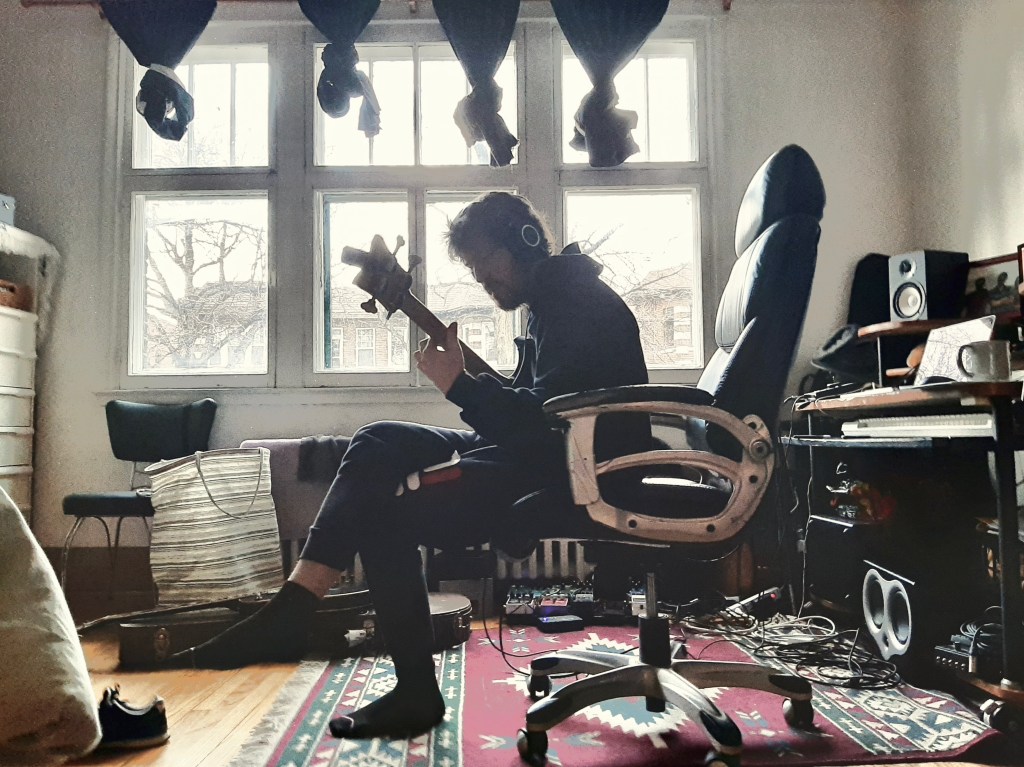
On the 11th of December I sat down with Clément Langlois-Légaré to discuss his musical motivations. Clément is the lead guitarist for Clay and Friends who’ve toured across North America and Europe with over 1,000 shows under their belt. Recently awarded Révélations Radio-Canada’s song of the year and amassing over 7,000,000 Spotify plays on their 2019 album La Musica Popular De Verdun. We talked about how to succeed in music business, staying humble, and plans for the future. Unfortunately, I forgot to ask Clémént for his favourite drink, so this one’s a mystery.
N.810 – How did you get into music?
Clémént Langlois-Légaré – I followed a specific path into music. My dad is a professional musician as well, so from a young age instruments were laying around the house. I started playing the guitar around 5 or 6 years old, imagine a house with a drum set in the living room, tons of guitars around and a recording setup in the basement, that’s where I grew up. I made my first beat in the 9th grade so I didn’t really question what I was going to do after high school. I was in the music program there, I studied Conservatoire de Musique Classique, I studied music in Cegep, and got my Masters in Music Composition for Film. Music was really rooted in passion for me, but the academic side was a big part as well. Around three-quarters of the producers I work with don’t necessarily know how to play a chord, so my background helps a lot, composing is my strength compared to other guys in the business. I do a lot of production myself so I’m kind of a middleman. I understand the producer and musician’s perspective.

N.810 – How was music school for you? Was it a worthwhile investment?
C.L.L. – It’s all about the teachers you get, I was fortunate to have passionate teachers who believed in me. When you start lessons you begin with the basics and technique, but the more you advance through the stages up to or even after University, there’s a lot of life coaching that goes on. We would have hour-long sessions at University where we just talked about music. They would show me stuff, they would give me sparks and let me digest and try to make it my own. Music school was definitely a good thing, it was about making sure I understood the spark and how to apply it to my work.
N.810 – Was there a moment where you decided to pursue music professionally?
C.L.L. – There are definitely specific moments where things clicked. I never thought of it as a job until the band started booking shows and making money. In the last year I’ve needed to check my finances, copyrights, playing rights, all of a sudden, the business side shows up and now it really is a job. There were moments where I knew. My first show for example, the first time we played a huge festival, the first time we toured Europe. These were all moments I realized this was my passion and I could see myself doing this the rest of my life. I never wanted to do anything else.

N.810 – How was the transition from a small local band to touring across Canada and Europe?
C.L.L. – The situation was super simple because some projects get a major break and they skip steps, not us, we did every step imaginable. We never had a song blow up, so instead we toured, we did the first album, we screwed up with the big label, we got our own team for PR, management and distribution. We really took one step at a time. It’s also a matter of getting up there and staying up there. It’s harder to slip and fall if you’ve built every step behind you one at a time.
N.810 – Any advice for up and comers planning on joining a label or going independent?
C.L.L. – You have to be careful. Know where you are in your career and know there’s no perfect deal. The more you work on your stuff the better the offers are going to be. I would say once you’re ready to make the move, make sure to have good lawyers check the contracts, see if there are better offers around, but you really have to connect with the people. It’s not the contract you sign, it’s the people. The team that joins your project is important. It’s easy to get charmed by the numbers, they’re going to offer a big cash advance and a big cheque but the people you deal with everyday are the most important thing. You have to get introduced to the business side of things if you want to make a living. it’s music business, two words. You have to be on top of your game in both and be well-informed because at the end of the day, the business side can allow you to make music more peacefully.
You can follow Clement @
 Numero810